1

American painting and its tradition — Inside the Classic
608
7
Project Gutenberg
2024
Painters -- United States; Painting -- United States
Readers of public-domain and historical texts
Project Gutenberg digital edition
en
Edition facts
Words: 63,998
Reading time: 279 min
Text sections: 15
Source:
Project Gutenberg record #73811
Van Dyke profiles nine American painters active between 1878 and 1915, examining their techniques, influences, and contributions. The book emphasizes the artists' break from European traditions and their role in establishing a distinct American school, with detailed analysis of works and critical reception.
Editorial Edition Score
4.8/5
★★★★★
★★★★★
Calculated from edition completeness, EPUB availability, text structure and catalogue metadata. Not a user rating.
Edition quality
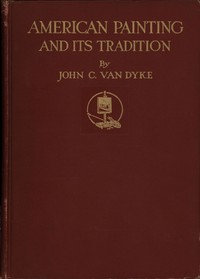
John C. Van Dyke's American Painting and Its Tradition (1919) examines nine painters—Inness, Wyant, Martin, Homer, La Farge, Whistler, Chase, Alexander, and Sargent—who shaped American art from roughly 1878 to 1915. Van Dyke writes from a close vantage point, having known several of the artists personally, and his assessments blend technical observation with biographical anecdote. The book is structured as a series of independent chapters, each devoted to a single painter, and the preface frames the period as a closed chapter, allowing for historical perspective.
A Critic’s Stance on Art Criticism
In the chapter on La Farge, Van Dyke recounts a revealing exchange. La Farge had sent him a copy of Considerations on Painting and later remarked that he had read thousands of pages of art criticism “without finding anything that a person seriously devoted to his profession of art could find of the slightest use.” Van Dyke countered that criticism aims not to instruct artists but to serve the public, and that the critic, like the painter, pursues his own artistic design in words. This passage illuminates Van Dyke’s own method: he writes for the lay reader, explaining what might otherwise be overlooked, and he values clarity over vehemence. He contrasts La Farge’s calm, inquiring style with Ruskin’s “hectic vein,” and notes that La Farge’s book “is an epitome of La Farge’s method of thinking.” The exchange also reveals Van Dyke’s willingness to engage directly with his subjects’ ideas, making the book as much a commentary on criticism as on painting.
The Painter as Writer: La Farge’s Dual Talent
Van Dyke repeatedly emphasizes that La Farge possessed “the literary sense quite as much as the pictorial.” He notes that La Farge’s travel volumes on Japan and the South Seas are “impressionistic in that they record moods, thoughts, and talks,” and that they form “a quite perfect text for his sketches.” Van Dyke even speculates that had La Farge chosen literature, he might have risen as high as in painting. This observation is grounded in specific details: La Farge advised Henry James to take up literature, and James, in turn, “had the pictorial cast of mind.” The chapter also praises La Farge’s Considerations on Painting as “the best piece of art criticism put forth in America,” ranking it with Fromentin’s Les Maîtres d’autrefois. Van Dyke’s treatment of La Farge’s writing is unusually thorough for a book ostensibly about painting, suggesting that the author sees verbal and visual artistry as deeply connected.
Periodization and the “New Movement”
Van Dyke explicitly dates the period he covers from about 1878 to 1915, calling it “practically closed” by the time of writing. The preface states that the men who “broke ground years ago in the Society of American Artists have turned their furrow and had their day.” This framing allows Van Dyke to treat the nine painters as a coherent group whose work is finished and can be viewed historically. He acknowledges that “dozens of painters became identified with the one-time ‘new movement,’” but he selects only these nine as representative. The book’s structure—separate chapters with no overarching narrative—reflects this sense of discrete, completed careers. Van Dyke’s tone is evaluative but not eulogistic; he notes that the newer generation has “different aims and aspirations,” implying that the tradition he describes is no longer dominant. This historical consciousness shapes every chapter, as Van Dyke constantly measures his subjects against both European predecessors and American successors.
Van Dyke’s book is best read as a series of critical portraits rather than a continuous history. Readers interested in the artists’ techniques will find detailed observations on brushwork, color, and composition, while those curious about the period’s intellectual climate will appreciate the anecdotes and critical debates. The author’s personal acquaintance with several painters adds a layer of immediacy, but his judgments remain analytical. For a full understanding, one should consult the illustrations that accompany the text, as Van Dyke frequently refers to specific works.
Reader reflection
How will you remember this book?
Save your reaction, strongest insight, and memorable passage.
Your progress
0
/
10
2
Was reading this book enjoyable?
3
Would you recommend this book to another reader?
4
Did the language feel accessible?
5
What did you appreciate most?
6
Would this book work well in a reading group?
7
Would you read this book again?
8
Did the book deliver what you hoped for?
9
What changed or sharpened your thinking?
10