1

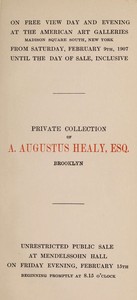
Catalogue of valuable paintings and water colors mostly of the modern Dutch school, forming the private collection of A. Augustus Healy, Esq., Brooklyn — Story, Setting & Ideas
895
8
Project Gutenberg
2023
Healy, A. Augustus (Aaron Augustus), 1850-1921 -- Art collections -- Catalogs; Art -- Private collections; Auction catalogs
Readers of public-domain and historical texts
Project Gutenberg digital edition
en
Edition facts
Words: 15,709
Reading time: 69 min
Text sections: 98
Source:
Project Gutenberg record #70649
This 1907 auction catalog documents the sale of A. Augustus Healy's collection of modern Dutch and European paintings, with detailed descriptions of each lot's composition, lighting, and provenance.
Editorial Edition Score
4.7/5
★★★★★
★★★★★
Calculated from edition completeness, EPUB availability, text structure and catalogue metadata. Not a user rating.
Edition quality
The catalog opens with seven conditions of sale that explicitly disclaim responsibility for "correctness of the description, genuineness, or authenticity" of any lot, while offering a mechanism for expert challenge before the sale. This legal preamble frames the descriptive entries that follow, which are remarkably precise about visual effects—such as "a shaft of sunlight breaks well up toward the zenith" in J. Francis Murphy's A Hillside Pasture—yet remain silent on attribution disputes or market value.
Descriptive Precision as a Selling Tool
Each entry in the catalog provides dimensions, signature location, and a paragraph describing the scene in painterly terms. For example, Charles François Daubigny's A Showery Day in Spring is noted for "a luminous sky filled with thin drifting clouds, catching here and there the diffused light from the sun." The language emphasizes atmospheric effects—light, cloud, water reflection—over narrative or historical context. This suggests the catalog was aimed at buyers who valued technical execution and mood over subject matter.
The descriptions also note provenance, such as "Collection of H. Wood Sullivan, New York, 1903" for works by Murphy and Childe Hassam. This brief chain of ownership adds a layer of credibility without making claims about the work's importance.
The Auctioneer's Disclaimers vs. the Catalog's Authority
The conditions of sale create a tension: the auction house refuses to guarantee authenticity, yet the catalog entries present each painting with confident specificity. Condition 5 allows a buyer to challenge a work before the sale with "trustworthy expert opinion," after which the lot would be sold "subject to the declaration of the aforesaid expert." This mechanism shifts the burden of proof to the buyer, while the catalog itself functions as a persuasive but legally non-binding document.
Notably, the catalog does not include estimated prices or reserve amounts. The focus remains on visual description and provenance, leaving financial matters to the auction floor. This separation of aesthetic appeal from commercial negotiation is characteristic of early 20th-century auction practice.
The Collection's Composition: Dutch School and Beyond
Although the title emphasizes "the modern Dutch school," the excerpts include works by American and French artists: J. Francis Murphy, Childe Hassam, Daubigny, Boudin, and Anton Vollon. The catalog's subject headings in the Project Gutenberg record list "Healy, A. Augustus — Art collections — Catalogs" and "Auction catalogs," but the actual contents reveal a broader geographic range. This mismatch between the catalog's billing and its contents suggests that the Dutch school may have been the core, but Healy's collection also encompassed Barbizon and American tonalist works.
The descriptions themselves do not classify works by nationality or school; they treat each piece as an individual object. The catalog thus functions as a practical sales list rather than a scholarly survey.
Readers interested in the history of art collecting or auction practices will find this catalog a primary source for how paintings were marketed in 1907. The contrast between the legal disclaimers and the evocative descriptions reveals the auction house's dual role as promoter and risk manager. For provenance researchers, the brief ownership notes offer starting points, though the catalog does not claim completeness.
Reader reflection
Your personal reading reflection
Build a private reading journal entry for this title.
Your progress
0
/
10
2
What was your overall reaction to the book?
3
Would you pass this book on to a friend?
4
What was the reading difficulty like?
5
Which element worked best for you?
6
How well did it match your expectations?
7
What did you think about the pace?
8
Did the book give you something worth debating?
9
What changed or sharpened your thinking?
10