1

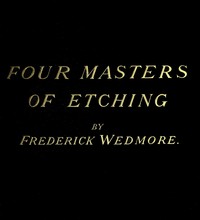
Four Masters of Etching — Text and Context
242
5
Project Gutenberg
2021
Whistler, James McNeill, 1834-1903; Haden, Francis Seymour, 1818-1910; Jacquemart, Jules-Ferdinand, 1837-1880; Legros, Alphonse, 1837-1911; Etching -- 19th century
Readers of public-domain and historical texts
Project Gutenberg digital edition
en
Edition facts
Words: 19,585
Reading time: 86 min
Text sections: 9
Source:
Project Gutenberg record #66392
Frederick Wedmore's 1883 study examines four pioneering etchers—Haden, Whistler, Jacquemart, Legros—through detailed analysis of technique and style, emphasizing their distinct contributions to the medium's development.
Editorial Edition Score
4.6/5
★★★★★
★★★★★
Calculated from edition completeness, EPUB availability, text structure and catalogue metadata. Not a user rating.
Edition quality
Frederick Wedmore opens his 1883 study by declaring his four subjects 'pioneers' of modern etching, a claim he supports not with sweeping praise but with close attention to each artist's technical choices. The book's preface admits its limited scope—only four figures—yet insists this allows a 'degree of detail' impossible in broader surveys. Wedmore's critical voice is notably self-aware: he revises earlier judgments on Whistler, explaining that 'in a system of criticism which seeks to inquire and understand, rather than to denounce, there is place for change.' This willingness to adjust opinion, paired with a focus on the material qualities of etchings—line, tone, scale—shapes the book's analytical approach.
Wedmore's Critical Method and Its Limits
Wedmore's criticism is grounded in direct observation of individual prints, but he also reveals his own biases. He dismisses Bracquemond's work as 'very limited' despite acknowledging its skill, and he measures Whistler's portraits against an expectation of 'expressiveness' that the artist's own theories might reject. The preface notes that earlier chapters on Haden, Legros, and Jacquemart had been 'revised' from periodical publications, suggesting a deliberate refinement of argument. Yet Wedmore does not pretend to completeness: he admits that a broader book would have included Macbeth and Tissot, and he declines to discuss the 'relation of Art to Nature and Life' at length. This self-imposed restraint gives the essays a focused, almost technical character, though it also leaves gaps—for instance, how Whistler's decorative work relates to his etchings is only hinted at.
Whistler: Between Decoration and Portraiture
Wedmore's chapter on Whistler is the most conflicted. He praises the 'Nocturnes' as 'the record of impressions' that are 'restful to the eye' yet faults them for lacking 'patient achievement.' The discussion of Whistler's decorative panels for Leyland's house acknowledges their 'strikingly original' colour solutions, but Wedmore immediately contrasts this with the artist's 'rarely mastered' human form. He singles out the portrait of Whistler's mother for its 'dignified quietude' and 'reticent pathos,' while noting that the 'straight and stiffish disposition of the lines' is more peculiarity than merit. The analysis of A Variation in Flesh-colour and Green admires its 'cool refreshment' but dismisses the draughtsmanship as 'anything but searching.' Wedmore's tone is evaluative throughout, weighing strengths against weaknesses without resorting to blanket approval.
The Vocabulary of Etching: Line, Tone, and Scale
Wedmore's language is precise about physical qualities. He describes Whistler's large-scale paintings as 'well-considered sketchiness' and notes that they 'suffer curiously when placed against work of patient achievement.' The preface distinguishes his own project from Hamerton's by promising 'detail' rather than breadth. In the Whistler excerpt, Wedmore uses terms like 'harmonies,' 'variations,' and 'scherzo' to align etching with musical structure—a common 19th-century analogy, but here applied specifically to colour arrangements. He also attends to the material conditions of viewing: the Leyland decorations are considered 'on the large scale on which they are painted,' while the cabinet pictures demand different scrutiny. This sensitivity to scale and medium suggests that Wedmore's criticism is as much about the physical object as about artistic intent.
Wedmore's essays reward readers who attend to his specific observations—a comment on line, a note on scale—rather than expecting a unified theory of etching. The book's value lies in its willingness to judge individual works on their own terms, even when those judgments shift over time. For those interested in how Victorian critics parsed the emerging modernist tendencies of Whistler and his contemporaries, this volume offers a detailed, if partial, record.
Reader reflection
How will you remember this book?
Save your reaction, strongest insight, and memorable passage.
Your progress
0
/
10
2
Was reading this book enjoyable?
3
Is this a title you would suggest to others?
4
How demanding did the text feel?
5
Which aspect of the book did you value most?
6
Did the story or argument move comfortably?
7
How valuable was this book for your own interests?
8
How personally connected did you feel to the book?
9
Which lesson or insight stayed with you?
10