1

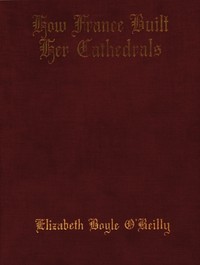
How France Built Her Cathedrals: A Study in the Twelfth and Thirteenth Centuries — Reading Companion
630
6
Project Gutenberg
2012
Cathedrals -- France; Architecture, Gothic
Readers of public-domain and historical texts
Project Gutenberg digital edition
en
Edition facts
Words: 236,510
Reading time: 1029 min
Text sections: 47
Source:
Project Gutenberg record #41687
An architectural study examining the evolution of Gothic cathedrals in twelfth- and thirteenth-century France, focusing on structural innovations, regional schools, and the cultural forces that shaped them, with attention to authorial voice and descriptive detail.
Editorial Edition Score
4.9/5
★★★★★
★★★★★
Calculated from edition completeness, EPUB availability, text structure and catalogue metadata. Not a user rating.
Edition quality
O'Reilly opens her study not with a definition of Gothic but with a question: 'What is Gothic architecture?' Her answer unfolds through a comparative lens, tracing the logical fulfillment of Romanesque forms. She writes that Gothic architecture is 'the logical fulfillment of Romanesque,' a phrase that sets the tone for a work deeply engaged with structural evolution. The author's voice is authoritative yet personal, often slipping into vivid imagery—as when she describes the 'horrors of the IX and X centuries in France' and the subsequent 'rebirth of the builders’ energy after the year 1000.' This blend of technical analysis and evocative narrative characterizes the entire book.
Diction and the Rhetoric of Rebirth
O'Reilly's word choices frequently invoke organic growth and revival. She speaks of 'the logical fulfillment of Romanesque' and 'rebirth of the builders’ energy,' framing architectural change as a natural, almost biological process. This diction extends to her treatment of historical periods: the 'horrors of the IX and X centuries' give way to a 'rebirth' after the year 1000, echoing the language of Renaissance humanism. Such phrasing is not merely decorative; it shapes the reader's understanding of Gothic as an inevitable flowering rather than a sudden invention. The author also uses personification, as when she writes that 'France built her cathedrals,' implying a collective, almost feminine agency. This rhetorical choice aligns with the book's title and reinforces a nationalistic narrative of architectural progress.
Dialogue and the Skeptical Historian
O'Reilly engages directly with historical controversies, particularly the Albigensian Crusade. She questions the authenticity of the famous phrase 'Kill them all, God will know his own,' attributed to Abbot Arnaud of Cîteaux. Her reasoning is meticulous: 'No contemporary chronicle mentions it and Albigensian historians would certainly have flung such words at the crusaders.' She notes that the phrase first appears in a German monk's history 'long after the Midi crusade,' and dismisses that chronicler as filled with 'discredited assertions.' This passage reveals O'Reilly's critical approach to sources—she weighs evidence, considers motive, and refuses to repeat unsubstantiated claims. Her dialogue with the past is not passive; she actively interrogates the reliability of her materials.
Descriptive Vividness and the Sense of Place
O'Reilly's descriptions of cathedrals and landscapes are strikingly sensory. She evokes the 'stately terrace called the Peyrou, built in the artificial, distinguished style of Louis XIV,' from which one sees 'a most lovely landscape of Midi fertility.' In another passage, she describes the tocsin bells that 'sounded its lamentable notes of alarm over all the land of France,' and the 'voice of the bells long condemned to silence by the authorities suddenly rang out everywhere.' These passages blend architectural observation with emotional resonance. The author does not merely list features; she creates atmospheres. Her description of Montpellier's cathedral as 'built from 1364 to 1367 as a monastery church' is followed by a reflection on intellectual history: 'cathedrals are built with more than stones.' This interplay of physical and cultural description is a hallmark of her style.
Structure and the Interplay of Narrative and Analysis
The book's structure alternates between broad historical surveys and focused case studies. Chapter I, 'What Is Gothic Architecture?' sets up a comparative framework, discussing Romanesque schools in Normandy, Burgundy, Auvergne, and elsewhere. Subsequent chapters zoom in on specific monuments, such as Abbot Suger's St. Denis. O'Reilly uses this structure to build a cumulative argument: Gothic architecture emerges from regional diversity and is shaped by political, liturgical, and social forces. The narrative is punctuated by vivid set pieces, like the description of the Albigensian Crusade's aftermath, which serves as a cautionary tale about the dangers of religious violence. This structural choice allows O'Reilly to maintain momentum while delivering detailed technical information. The reader moves from the general to the particular and back again, gaining both breadth and depth.
Readers attentive to O'Reilly's authorial choices will find a work that is as much about the writing of history as about stone and mortar. Her diction, her skeptical handling of sources, and her vivid descriptions all contribute to a portrait of an era seen through the eyes of a scholar who is also a storyteller. The book rewards those who read not only for architectural facts but for the craft of historical narrative itself.
Reader reflection
Before you leave, reflect on the book
Use these questions to collect your thoughts before moving on.
Your progress
0
/
10
2
Did this book hold your interest?
3
How likely are you to recommend this book?
4
How demanding did the text feel?
5
Did this book create an emotional response?
6
How would you rate its originality?
7
Did the book meet your expectations?
8
How useful were the ideas in this book?
9
In one sentence, what did you learn?
10