1

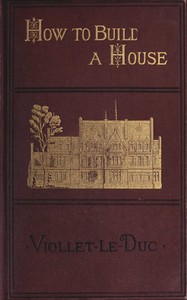
How to build a house — Themes and Context
1545
10
Project Gutenberg
2023
Architecture, Domestic; Building
Readers of public-domain and historical texts
Project Gutenberg digital edition
en
Edition facts
Words: 75,175
Reading time: 327 min
Text sections: 35
Source:
Project Gutenberg record #71669
Viollet-le-Duc's architectural novelette follows Paul's house-building journey, blending narrative with technical instruction. The translator's note and excerpts reveal a tension between universal principles and French-specific practices, while the character M. Durosay embodies amateur building folly.
Editorial Edition Score
4.9/5
★★★★★
★★★★★
Calculated from edition completeness, EPUB availability, text structure and catalogue metadata. Not a user rating.
Edition quality
Viollet-le-Duc's How to Build a House is subtitled 'an architectural novelette,' a hybrid form that the translator Benjamin Bucknall, himself an architect, describes as 'practically instructive and fascinating.' The book embeds technical discussion within a story about Paul, a character who gets an idea and develops it with help. The excerpts show that the narrative is set against the Franco-Prussian War, with characters gathered at a château anxiously awaiting news. This wartime backdrop contrasts with the domestic building project at the story's center, suggesting that the book's instructional content is framed by broader social and historical circumstances.
A Hybrid Form: Novelette and Manual
The translator's note foregrounds the book's dual nature: it is both a 'lively narrative' and a 'minute and thorough discussion' of building processes. Bucknall emphasizes that Viollet-le-Duc wrote and illustrated the work during two months in the Alps while surveying for the French government—a fact that underscores the author's practical expertise. The excerpts themselves confirm this blend: the story introduces characters like Paul and M. Durosay, while the table of contents lists chapters such as 'Paul Gets an Idea' and 'The Tree of Knowledge,' alongside presumably technical chapters. This structure suggests that the narrative serves as a vehicle for architectural instruction, a method Bucknall praises for keeping 'attention agreeably relieved.' However, the excerpts do not reveal how deeply the technical content is integrated into the plot, leaving open the question of whether the story or the instruction dominates.
French Specificity vs. Universal Principles
Bucknall's note explicitly acknowledges that the book's 'scene is laid in France' and that many arrangements 'only apply to the social conditions and requirements of the French.' Yet he argues that the 'value of the principles laid down' is not lessened, since they are 'of general application.' This tension is evident in the excerpts: the narrative is set in a French château during the Franco-Prussian War, with characters discussing national events. The character M. Durosay, a self-styled expert who has failed at building and road-making, embodies a type of amateurism that might be culturally specific. Bucknall suggests that an English reader could adapt the principles to build an 'English house,' but the excerpts do not show how Viollet-le-Duc handles this cultural specificity. The catalog subjects—'Architecture, Domestic' and 'Building'—do not capture this national framing, which is central to the translator's presentation.
The Character of M. Durosay: A Cautionary Figure
The most extended excerpt introduces M. Durosay, a visitor to the château who 'had taken the sole direction of his building operations' with disastrous results: 'one fine morning his building fell to pieces.' He is described as a man who 'judged everything by an à priori system' and would 'let the train go rather than not give a formal judgment.' This portrait serves as a warning against amateurism in building, a theme that likely runs through the book. Durosay's failures—in building, road-making, and manufacturing—contrast with the systematic approach Viollet-le-Duc presumably advocates. The excerpt does not reveal whether Durosay becomes a foil for Paul or a source of comic relief, but his presence suggests that the book critiques the very kind of uninformed opinion it might otherwise attract. The catalog subjects do not hint at this narrative element, which is essential to understanding the book's rhetorical strategy.
Readers approaching How to Build a House should be prepared for a work that is neither pure novel nor pure manual. The excerpts suggest that the narrative context—including the war setting and the character of Durosay—shapes the instructional content in ways that a straightforward reading guide might miss. Pay attention to how Viollet-le-Duc uses story to frame technical advice, and consider whether the principles he advocates transcend their French origins as Bucknall claims.
Reader reflection
Your personal reading reflection
Build a private reading journal entry for this title.
Your progress
0
/
10
2
Was reading this book enjoyable?
3
Would you encourage someone else to read it?
4
Did the language feel accessible?
5
How strongly did the book affect you emotionally?
6
How clearly were the main ideas presented?
7
Would this book work well in a reading group?
8
Could you see yourself revisiting this book?
9
What is the main idea you are taking away?
10