1

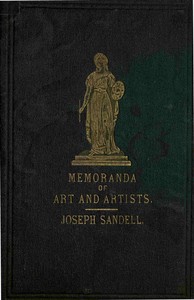
Memoranda of art and artists, anecdotal and biographical — A Reader’s Guide
1437
10
Project Gutenberg
2024
Art -- Anecdotes; Artists -- Anecdotes; Artists -- Biography
Readers of public-domain and historical texts
Project Gutenberg digital edition
en
Edition facts
Words: 62,609
Reading time: 273 min
Text sections: 12
Source:
Project Gutenberg record #74887
Joseph Sandell's 1871 collection of artist anecdotes, arranged alphabetically, offers glimpses into the lives and characters of painters and sculptors through brief, often humorous or revealing stories sourced from various authorities.
Editorial Edition Score
4.8/5
★★★★★
★★★★★
Calculated from edition completeness, EPUB availability, text structure and catalogue metadata. Not a user rating.
Edition quality
Joseph Sandell’s Memoranda of Art and Artists (1871) is a compendium of short anecdotes about painters and sculptors, arranged alphabetically by artist. The preface explains that Sandell gathered these stories over several years, finding that living artists were often reluctant to supply material, so he turned to published sources. The result is a series of vignettes that aim to illuminate the character and career of each artist, from Washington Allston to David Teniers.
The excerpts show a work that moves briskly from one figure to the next, mixing biographical summary with quoted or paraphrased incidents. Sandell’s method is to select, arrange, and occasionally abridge his sources, giving credit where possible. The tone is informal and anecdotal, with a clear interest in the human side of artistic production.
Alphabetical Structure and the Role of the Compiler
Sandell organizes his material alphabetically by artist surname, a simple but effective framework for a reference work. The excerpts show entries for Allston, Bartolozzi, Beechey, Chantrey, Collins, Constable, Copley, David, Denon, and Teniers, among others. Each entry typically begins with a brief biographical note—birth, training, major works—followed by one or more anecdotes. For example, the entry on David Teniers the Younger notes his nickname “the Ape of Painting” and his skill in imitating any style, then moves into a long quoted passage from Payne’s “Royal Dresden Gallery” describing a scene in a village alehouse.
Sandell’s role as compiler is evident in his prefatory remarks about the difficulty of obtaining anecdotes from living artists. He positions himself as a collector and arranger rather than an original author, and the excerpts bear this out: the Teniers anecdote is presented as an extract, with the source named. This transparency about sources gives the work a documentary quality, even as the anecdotes themselves are often lively and conversational.
Anecdotes as Windows onto Character
The anecdotes Sandell selects frequently reveal personality traits, professional rivalries, or unexpected encounters. The entry on Francesco Bartolozzi includes an interview with George III, while Sir William Beechey’s entry recounts an interview with the writer Thomas Holcroft. These are not merely biographical facts but stories that show artists in interaction with patrons, critics, or peers. The Chantrey entry covers his prices, his encounter with Horne Tooke, and a “candid opinion” on fashion, suggesting a range of social and professional contexts.
Sandell’s choices tend toward the piquant or the morally instructive. The David entry, for instance, includes subheadings on “His Marriage,” “His Cruelty,” and “His Excessive Vanity,” indicating a focus on the artist’s less admirable traits. The Teniers anecdote, by contrast, is a detailed narrative of a negotiation over a dowry, complete with dialogue and character sketches. This variety keeps the reader engaged, moving from scandal to humor to pathos within a few pages.
The Use of Quoted Sources and Embedded Narratives
Sandell frequently incorporates extended quotations from other works, as seen in the Teniers entry, which reproduces several paragraphs from Payne’s “Royal Dresden Gallery.” This embedded narrative describes a scene in a Flemish alehouse, with named characters (Jan van Bierlich, Willen, Mynheer Taaks, Izak) and a plot involving a marriage negotiation. The quoted passage is vivid and novelistic, with dialogue and descriptive detail that contrasts with Sandell’s own more concise biographical summaries.
This technique gives the reader a sense of entering a different voice and genre within the same volume. The European Magazine is also cited in the Teniers entry, providing a historical account of the popularity of stippled prints. Sandell thus creates a mosaic of sources, each with its own tone and perspective. The reader is reminded that these anecdotes are mediated through earlier publications, and that Sandell’s work is a gathering of existing materials rather than a wholly original composition.
The Reader’s Experience: Navigating a Victorian Curiosity Cabinet
Reading Memoranda of Art and Artists is akin to browsing a Victorian curiosity cabinet: each entry is a discrete object, often surprising, and the whole is held together by the alphabetical arrangement. The excerpts suggest that the book rewards dipping in at random as much as sequential reading. The Teniers anecdote, for instance, is self-contained and can be enjoyed without knowledge of the preceding entries. Similarly, the David entry’s subheadings allow a reader to pick out particular aspects of his life.
Sandell’s preface frames the volume as a leisure-hour diversion that might also arouse interest in the artists themselves. The excerpts bear this out: they are short enough to be read in a few minutes, but they often leave the reader curious about the larger context. The work does not aim to be a comprehensive biography but a series of glimpses, and its charm lies in the variety and human interest of those glimpses. For a first reading, the best approach may be to open to any page and let the anecdotes unfold.
Sandell’s collection is best approached as a companion to more systematic art histories, offering sidelights on character and incident that formal biographies often omit. The alphabetical arrangement makes it easy to locate a particular artist, but the real pleasure lies in the unexpected juxtapositions—a story of royal patronage next to a tavern quarrel. Readers interested in the social history of art, or in the Victorian taste for anecdotal biography, will find this a rich and entertaining source.
Reader reflection
What did you think of this book?
Answer a few questions and save a private reflection on this device.
Your progress
0
/
10
2
How did the book work for you overall?
3
Would you pass this book on to a friend?
4
How much effort did this book require?
5
How valuable was this book for your own interests?
6
Did any part of the book stay with you emotionally?
7
What was the strongest part of the book?
8
Did you relate to its people, ideas, or situations?
9
What is the main idea you are taking away?
10