1

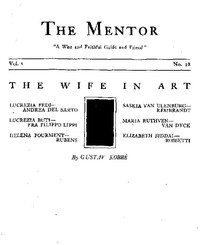
The Mentor: The Wife in Art, Vol. 1, Num. 28, Serial No. 28 — Text and Context
281
4
Project Gutenberg
2015
Artists -- Relations with women; Artists' spouses
Readers of public-domain and historical texts
Project Gutenberg digital edition
en
Edition facts
Words: 9,167
Reading time: 40 min
Text sections: 7
Source:
Project Gutenberg record #49892
Gustav Kobbé examines six artist-wife relationships through diction, dialogue, and description, arguing that these marriages fueled rather than hindered creative output, with specific observations on Browning's poem, Rubens' palette anecdote, and Rembrandt's portrait choices.
Editorial Edition Score
4.6/5
★★★★★
★★★★★
Calculated from edition completeness, EPUB availability, text structure and catalogue metadata. Not a user rating.
Edition quality
Gustav Kobbé opens his essay on the wife in art by quoting Browning’s Andrea del Sarto, where the painter muses on being outpaced by Leonardo, Raphael, and Angelo “because there’s still Lucrezia.” Kobbé immediately reframes the line: he notes Andrea adds “as I choose,” suggesting the artist preferred failure with his wife to triumph without her. This close reading of a single phrase sets the tone for the entire volume—a series of biographical sketches that treat each marriage as a deliberate, productive choice rather than a professional liability.
Lucrezia Fedi and the New Note in Religious Painting
Kobbé describes Lucrezia Fedi’s “dark, imperious beauty” as “a new note in religious painting,” pointing to works like the “Madonna of the Harpies” where her face dominates not only female figures but also boys and youths. He does not simply assert influence; he ties it to observable visual evidence. The author’s diction—calling her “the worst kind of wife a man can have”—is deliberately provocative, yet he immediately counters by claiming she kept Andrea “in a constant state of impecuniosity and jealousy” while also inspiring his finest work. This tension between moral judgment and aesthetic admiration recurs throughout the text.
Rubens and the Philosopher’s Stone
Kobbé recounts an anecdote in which an alchemist claims to have discovered the philosopher’s stone; Rubens replies, “I have discovered it myself,” and shows his palette. The story is presented as evidence of Rubens’ self-assurance and prosperity, contrasting with the financial struggles of other artists. The author’s choice to include this dialogue—rather than simply describing Rubens’ success—reveals his method: he uses reported speech to characterize the artist’s attitude toward his craft and his wife. Helena Fourment, Rubens’ second wife, is described as young and later remarried to a count, but Kobbé offers little analysis of her direct influence on the paintings.
Rembrandt’s Saskia: Jewels, Dresses, and Repeated Posing
Kobbé emphasizes Rembrandt’s transformation after meeting Saskia: the “sullen Hollander” becomes devoted, spending money on “jewels and gold ornaments and rich dresses” to adorn her. The author notes that Saskia posed “several times” as a queen or a flower girl, implying that her image was a flexible tool for Rembrandt’s experimentation. Kobbé’s description of Rembrandt as “awkward and shy” and “doing everything in his own queer way” relies on colloquial diction that humanizes the artist. The section stops short of analyzing specific paintings, instead focusing on the domestic and economic dynamics of the marriage.
The Structure of Influence: Six Portraits, One Argument
Kobbé organizes the volume as a series of six paired biographies, each following a similar pattern: introduce the artist, describe the wife’s character, and assert that the marriage spurred creativity. The repetition of this structure itself becomes a rhetorical device, reinforcing the thesis that “he rides fastest who rides alone” is false. The author uses Browning’s poem as a framing device, returning to it in the opening and closing sections. Notably, Kobbé does not claim access to the artists’ inner lives; he relies on public records, anecdotes, and the paintings themselves. The result is a work that blends art criticism with biographical narrative, always grounding its claims in specific, traceable details.
Kobbé’s essay is best read as a series of case studies in artistic partnership, each built from a mix of historical record and interpretive inference. Readers should attend to the way he selects and frames anecdotes—the Browning quotation, the alchemist story, the description of Saskia’s poses—as these choices reveal his own argument about the productive role of the wife in art. The volume does not attempt a comprehensive survey; it offers a focused, opinionated thesis supported by carefully chosen evidence.
Reader reflection
Record your reading impressions
A brief reflection can help important ideas stay with you longer.
Your progress
0
/
10
2
Did this book hold your interest?
3
How likely are you to recommend this book?
4
How demanding did the text feel?
5
Did any part of the book feel personally relevant?
6
Which element worked best for you?
7
How valuable was this book for your own interests?
8
Is this a title worth rereading?
9
What did this book teach you most?
10