1

The Architecture of Colonial America — Context and Discussion
862
6
Project Gutenberg
2019
Architecture, Colonial; Architecture -- United States
Readers of public-domain and historical texts
Project Gutenberg digital edition
en
Edition facts
Words: 66,495
Reading time: 290 min
Text sections: 13
Source:
Project Gutenberg record #59120
An analysis of Colonial American architecture through diction, dialogue, and description, focusing on the author's stylistic choices in discussing building styles, materials, and social contexts.
Editorial Edition Score
4.8/5
★★★★★
★★★★★
Calculated from edition completeness, EPUB availability, text structure and catalogue metadata. Not a user rating.
Edition quality
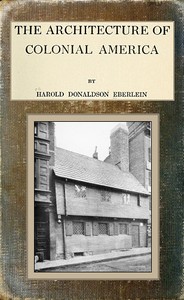
Harold Donaldson Eberlein's The Architecture of Colonial America (1915) opens with a foreword that frames the study as both a historical account and a critical analysis, aiming to connect architecture with the social and economic circumstances of the period. The author's diction is precise and evaluative, as seen in phrases like 'wealthy an architectural heritage' and 'careful critical analysis,' which set a scholarly yet accessible tone. The text frequently employs technical terms such as 'panelling,' 'friezes,' and 'compo decoration,' reflecting an audience of architects and general readers alike.
Diction and the Language of Craftsmanship
Eberlein's word choices reveal a deep engagement with the materiality of colonial buildings. He describes mantelpieces as 'an integrant portion of the room,' using 'integrant' to emphasize their structural and decorative unity. The phrase 'household shrine' elevates the fireplace to a sacred center, while 'quaint imagery' and 'master builder' evoke a nostalgic reverence for earlier craftsmanship. In discussing paint colors, he notes 'various shades of greys, blues, drabs, brownish yellows,' a list that grounds the analysis in specific, observable details. This lexical precision extends to architectural terms like 'Ionic pilasters' and 'base course,' which are used without explanation, assuming reader familiarity.
Dialogue with Architectural History
The author frequently invokes the voices of earlier architects and historians, creating a layered dialogue. He quotes a passage describing how Sir William Chambers 'dealt it the most crushing blow it had yet received' by prioritizing 'minute detail' over 'fine proportion.' This indirect speech conveys a critical stance while attributing judgment to historical sources. Eberlein also references 'Gibbs, Kent and Ware' as authorities, positioning his work within a tradition of architectural commentary. The use of 'we frequently find' and 'we are in better luck' creates a shared perspective with the reader, as if touring buildings together.
Descriptive Patterns and Visual Emphasis
Eberlein's descriptions often follow a pattern: naming a building, noting its stylistic type, then highlighting a distinctive feature. For example, 'At the Highlands, in the Whitemarsh Valley, we see the front of the house adorned with tall Ionic pilasters rising from base course to cornice, which is itself elaborately wrought.' The verb 'adorned' suggests ornamentation as deliberate choice. He contrasts this with Upsala, where 'the Adam mantels have remained untouched,' using 'untouched' to imply authenticity. The description of paint layers at Graeme Park—'the first coat of paint was grey, and no other colour ever adorned its panelling'—uses 'adorned' again, linking color to aesthetic intent.
Structure and the Reader's Journey
The book's structure moves from general principles to specific examples, with chapters organized by region or style. Eberlein signals transitions with phrases like 'Before proceeding further in the course of comparison,' which guide the reader through comparative analysis. He often concludes sections with a summary remark, such as 'The illustrations show the rest of the house and make further specific comment unnecessary,' deferring to visual evidence. This structural clarity mirrors the architectural order he admires, reinforcing his argument that design reflects social and economic conditions.
Readers attentive to Eberlein's authorial choices will notice how his diction, dialogue with historical sources, and descriptive patterns shape the narrative. The text rewards close reading of its technical vocabulary and evaluative language, which together construct a persuasive argument about the value of colonial architecture. For those interested in the intersection of language and material culture, this work offers a rich case study in early twentieth-century architectural criticism.
Reader reflection
Your personal reading reflection
Build a private reading journal entry for this title.
Your progress
0
/
10
2
Did this book hold your interest?
3
Would you recommend this book to another reader?
4
What was the reading difficulty like?
5
How original did the book feel?
6
Could you apply anything you learned?
7
How well did it match your expectations?
8
Would a second reading be valuable?
9
What did this book teach you most?
10