1

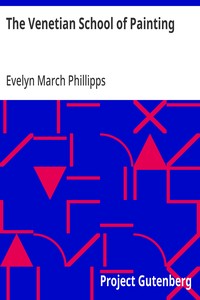
The Venetian School of Painting — Inside the Classic
536
6
Project Gutenberg
2009
Painters -- Italy -- Venice; Painting -- Italy -- Venice -- History
Readers of public-domain and historical texts
Project Gutenberg digital edition
en
Edition facts
Words: 78,954
Reading time: 344 min
Text sections: 12
Source:
Project Gutenberg record #30098
Evelyn March Phillipps traces the evolution of Venetian painting from its origins through its zenith to decline, focusing on how artists like Titian and Giorgione developed distinct styles. The narrative emphasizes changes in technique, composition, and emotional expression, particularly in Titian's late works.
Editorial Edition Score
4.8/5
★★★★★
★★★★★
Calculated from edition completeness, EPUB availability, text structure and catalogue metadata. Not a user rating.
Edition quality
Evelyn March Phillipps opens her study of Venetian painting with a clear purpose: to provide a portable volume that situates each master within the school's evolution, avoiding the exhaustive detail of earlier catalogues. The preface establishes a guiding philosophy—that the book aims to help readers 'rear a framework on which to found their own observations' rather than offer a complete list of painters. This deliberate selectivity shapes the entire work, focusing on major figures and their interrelations.
Titian's Late Style: From Broad Planes to Impressionist Dashes
Phillipps devotes considerable attention to Titian's final decades, describing a radical shift in technique. The 'Transfiguration' and 'Annunciation' in San Salvatore are 'dashed in, in the painter’s later style, in broad and sweeping planes without patience of detail.' She notes how Titian signed the latter 'Titianus, fecit, fecit' as a 'contemptuous reply' to critics. The late 'Shepherd and Nymph' recalls early Giorgione but with 'blurred and smouldering richness' and 'absolute negation of all sharp lines.' Phillipps categorizes these works as 'true impressionist order,' where close inspection reveals 'scumbled touches' and 'incoherent dashes,' yet stepping back brings 'order shines through the whole.' She quotes Vasari's observation that such works 'when close you cannot see them, but afar they look perfect.' This analysis ties technical change to the artist's defiant confidence.
Contrast and Emotion in Titian's Final Works
The 'Pietà' in the Academy, though unfinished, is described as 'nobly designed and very impressive.' Phillipps highlights its structure: a 'great dome-shaped niche' flanked by 'calm, antique, stone figures' whose 'impassive air contrasts with the wild pain and grief below.' The Magdalen 'steps out towards the spectator with the wailing cry of a Greek tragedy.' Yet she measures this against earlier Venetian masters: it 'hardly moves us like the concentrated feeling of Bellini’s Madonna, or the hurried, trembling grief of Tintoretto’s Magdalen.' The colour is 'deep greys mingled with a sombre golden glow, as of half-extinguished fires.' In contrast, the 'Christ Crowned with Thorns' at Vienna presents a 'tragic figure stupefied with suffering.' These descriptions reveal Phillipps's method of comparing emotional registers across painters to define the Venetian school's range.
Narrative Voice and the Shaping of a School
Phillipps writes with an authoritative yet accessible voice, frequently addressing the reader's experience. The preface explains that existing works are either 'biographical catalogues' that 'say little to readers who are not already acquainted' or multi-volume 'Lives' that 'make too large a library to be easily carried about.' Her solution is a single volume that 'pave the way to deeper and more detailed reading.' The prose is direct and evaluative: Titian's late output is 'enormous,' and his 'Pietà' is 'monumental in the sweeping grace of its line.' She uses contrasts to define—comparing Titian's late 'impressionist' approach to earlier precision, or his 'Pietà' to Bellini's and Tintoretto's treatments. This rhetorical strategy builds a coherent narrative of artistic development without overburdening the reader with minor names.
Phillipps's study rewards readers who attend to her comparative judgments and her focus on technical evolution. The excerpts show a writer who values both the broad arc of history and the telling detail—a signature, a Vasari quote, a description of colour as 'half-extinguished fires.' For those using this edition, reading with an eye to how she links painter to painter will illuminate the Venetian school's internal dialogues.
Reader reflection
How did this book work for you?
Your answers remain private and are stored only in this browser.
Your progress
0
/
10
2
What was your overall reaction to the book?
3
Would you encourage someone else to read it?
4
Did the language feel accessible?
5
How original did the book feel?
6
Could you apply anything you learned?
7
How closely did the book connect with your experience?
8
Was the book easy to understand?
9
What is the main idea you are taking away?
10