1

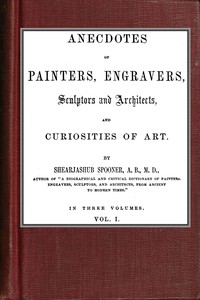
Anecdotes of Painters, Engravers, Sculptors and Architects, and Curiosities of Art (Vol. 1 of 3) — A Reader’s Guide
1153
3
Project Gutenberg
2021
Art -- Anecdotes; Artists -- Anecdotes
Readers of public-domain and historical texts
Project Gutenberg digital edition
en
Edition facts
Words: 79,593
Reading time: 347 min
Text sections: 9
Source:
Project Gutenberg record #66010
Shearjashub Spooner's 1853 collection of artist anecdotes, drawn from classical and Renaissance sources, with a focus on the trials and triumphs of sculptors and painters. The first volume covers figures from Phidias to Praxiteles, emphasizing the human stories behind famous works.
Editorial Edition Score
4.7/5
★★★★★
★★★★★
Calculated from edition completeness, EPUB availability, text structure and catalogue metadata. Not a user rating.
Edition quality
Shearjashub Spooner, a physician and art historian, opens his 1853 volume with a personal confession: he has spent five years in near-total seclusion, working from midnight to dawn on publishing ventures he fears may not find an audience in a “romance-loving” age. This preface sets the tone for a work that is neither dry biography nor mere compilation, but a labor of love—Spooner writes con amore—aimed at rescuing the “trials, misfortunes, achievements and exaltations” of artists from oblivion.
The anecdotes that follow are drawn from classical authors like Pausanias, Pliny, and Lucian, as well as Renaissance sources, and are arranged loosely by artist. Spooner’s voice is that of a learned enthusiast who interjects his own opinions, as when he calls Phidias “the most renowned sculptor of antiquity” and quotes Quintilian’s epithet “the Sculptor of the Gods.” The narrative pace shifts between brisk summaries and extended set-pieces, such as the story of Phryne’s ruse to obtain Praxiteles’ Cupid.
The Author’s Self-Portrait
Spooner’s preface is the most personal passage in the volume. He describes his “untiring industry” and the sacrifices made to publish Boydell’s Illustrations of Shakspeare and his own Dictionary. He claims he spent only one evening out of his study per week for five years, “relinquishing his toil only at midnight, to be resumed at dawn.” This self-portrait of a driven, almost ascetic scholar colors the entire book. Spooner presents himself as a man who has risked “many thousands of dollars” on art publishing in a country where the fine arts are precarious. He hopes his anecdotes will “arrest the attention or move the heart,” suggesting he sees his work as a corrective to public indifference.
The preface also reveals Spooner’s ambition: he has “abundant materials for three more volumes” and mentions his ongoing project to restore Napoleon’s Musée Français. This blend of personal confession and scholarly mission gives the book a distinctive, earnest tone.
Classical Anecdotes: Wit and Devotion
The anecdotes about ancient Greek artists are the most vivid in the volume. The story of Praxiteles and Phryne is a model of narrative economy: Phryne sends a false alarm that the sculptor’s workshop is burning, and Praxiteles cries out, “all is lost, if my Satyr and Cupid are not saved!” The ruse reveals his true favorites. Spooner then adds a scholarly note, citing Pliny’s ranking of the Cupid and mentioning a Vatican copy.
Another anecdote concerns the Venus of Cnidus: King Nicomedes of Bithynia offered to pay the city’s debt of a hundred talents for the statue, but the citizens refused, “regarding it as the principal glory of the state.” Spooner’s phrasing emphasizes their honor over wealth. The Phidias entry is more encyclopedic, detailing the gold-and-ivory statue of Minerva and the sculptor’s trick of inscribing his portrait on the shield. These stories balance human cunning, civic pride, and artistic genius.
Pace and Structure: From Summary to Scene
Spooner varies his narrative pace considerably. The Phidias section begins with a biographical summary—birth date, epithets, patrons—then shifts to a detailed description of the Parthenon statue, including the weight of gold (forty talents) and the materials (ivory, precious stones). The pace slows for the anecdote of the hidden portrait, then quickens again with a mention of the Elgin marbles and Canova’s praise.
In contrast, the Praxiteles story is almost entirely scenic, with dialogue and a punchline. The Nicomedes anecdote is a single paragraph of cause and effect. This alternation between dense factual reporting and lively vignette keeps the reader engaged. Spooner also uses direct quotations from ancient sources—Pausanias, Lucian, Plutarch—to lend authority, but he does not let them overwhelm his own voice. The result is a work that feels both scholarly and conversational.
Spooner’s volume rewards readers who enjoy the interplay of art history and human interest. The anecdotes are best approached not as a continuous narrative but as a series of independent episodes, each illuminating a different facet of artistic life. Pay attention to the author’s asides—his admiration for perseverance, his concern for the state of the arts in America—which give the book a personal dimension. The index in volume three will help locate specific artists, but the first volume stands on its own as a collection of stories that reveal how art was made, valued, and sometimes nearly lost.
Reader reflection
How did this book work for you?
Your answers remain private and are stored only in this browser.
Your progress
0
/
10
2
Did this book hold your interest?
3
How likely are you to recommend this book?
4
How demanding did the text feel?
5
How well did it match your expectations?
6
Would you read this book again?
7
What did you appreciate most?
8
Would you like to discuss this book with someone?
9
What did this book teach you most?
10