1

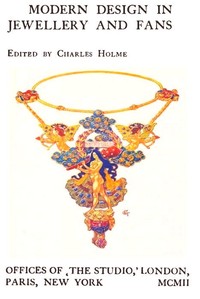
Modern Design in Jewellery and Fans — Context and Discussion
1303
3
Project Gutenberg
2015
Jewelry; Fans; Decoration and ornament -- Art Nouveau
Readers of public-domain and historical texts
Project Gutenberg digital edition
en
Edition facts
Words: 20,715
Reading time: 91 min
Text sections: 5
Source:
Project Gutenberg record #49559
An editorial note on the language, narrative voice, and pacing in Charles Holme's 1902 collection of essays on Art Nouveau jewellery and fan design, with observations on the contrasting national styles and the editor's Ruskinian framing.
Editorial Edition Score
4.7/5
★★★★★
★★★★★
Calculated from edition completeness, EPUB availability, text structure and catalogue metadata. Not a user rating.
Edition quality
The editor's preliminary note immediately establishes a moral and aesthetic framework by invoking John Ruskin's dicta against imitation and for invention. This sets a prescriptive tone that recurs throughout the volume, as each national survey measures its subject against a standard of originality and artistic integrity. The note's language is deliberate and earnest, with phrases like 'thorough belief of the soundness or these principles' (a typographical error that may reflect the period's typesetting) and 'beauty and freshness of treatment' signaling the editor's conviction that the featured works represent a progressive movement.
The volume's structure—five essays by different authors, each covering a national school—creates a polyvocal effect. The prose shifts from Gabriel Mourey's lyrical descriptions of French work to Aymer Vallance's more measured British assessments, and to W. Fred's historically layered account of Austrian jewellery. This variation in voice and pacing mirrors the editorial aim to present a comparative survey rather than a unified argument.
Ruskin as a Rhetorical Anchor
The editor's preliminary note quotes Ruskin twice, using his authority to frame the entire collection. This is not merely decorative; the quotations serve as a critical lens through which the subsequent essays evaluate their subjects. For instance, the Austrian essay by W. Fred implicitly echoes Ruskin when it criticizes American jewellery for prioritizing 'masses of precious stones' over artistic setting, and praises French work for throwing 'into the background the actual value of the jewels.' The Ruskinian preference for invention over imitation thus becomes a recurring touchstone, even when not explicitly cited.
The note's language—'never encourage the manufacture of any article not absolutely necessary'—is categorical, yet the volume itself includes decorative objects like fans, which are hardly necessities. This tension between Ruskin's moral austerity and the luxury items under discussion adds a layer of complexity to the editorial stance. The reader is left to consider whether the editor fully endorses Ruskin or uses him as a convenient rhetorical device.
National Voices and Shifting Pace
The five essays vary markedly in pace and density. Gabriel Mourey's contribution on French jewellery and fans tends toward flowing, appreciative prose, with sentences that linger on the 'beauty and freshness of treatment.' In contrast, Aymer Vallance's British section adopts a more catalog-like rhythm, listing designers and their works with less evaluative commentary. The Austrian essay by W. Fred is the most historically expansive, tracing influences from the baroque style through the Congress of Vienna to the 'liberating influence of the modern spirit.' Its longer paragraphs and digressions into cultural history slow the reading pace, offering a contrast to the more focused French and British sections.
This variation is not accidental; it reflects the different relationships each nation had with the Art Nouveau movement. The French essay's confident tone suggests a sense of ownership over the style, while the Austrian essay's historical framing implies a struggle for independence from French influence. The British essay's matter-of-fact listing may indicate a more tentative embrace of the new aesthetic.
The Editor's Curatorial Hand
Although Charles Holme is listed as editor, his presence is felt primarily through the selection of contributors and the framing preliminary note. The table of contents reveals a deliberate balance: five essays covering France, Britain, Austria, Germany, Belgium, and Denmark, with France and Britain receiving combined treatment of both jewellery and fans, while other nations are treated singly. This asymmetry suggests a hierarchy of importance, with France and Britain positioned as the leading centers of innovation.
The editor's note also acknowledges 'the courtesy of the owners of copyrights' and thanks 'all the artist-contributors, and especially to those who have made designs expressly for this publication.' This language of gratitude and collaboration underscores the volume's nature as a curated showcase rather than a critical history. The reader is thus oriented to approach the text as a document of its time—a snapshot of how early 20th-century connoisseurs sought to define and promote a new decorative style.
Readers approaching this volume should attend to the interplay between the editor's Ruskinian preface and the diverse voices of the essayists. The typographical error in the preliminary note ('soundness or these principles') serves as a reminder of the text's material history as a printed artifact. The varying pace and focus of the national surveys reward a comparative reading: one might read the French and Austrian essays consecutively to observe how different authors handle similar themes of influence and originality. The volume is best understood not as a definitive statement but as a conversation among early modernists about the values of their craft.
Reader reflection
Take a moment to reflect on this book
Create a short personal record of your experience with this book.
Your progress
0
/
10
2
Was reading this book enjoyable?
3
Is this a title you would suggest to others?
4
How easy was the book to follow?
5
Did the book deliver what you hoped for?
6
What did you think about the pace?
7
Was the book easy to understand?
8
Would you start a conversation about this book?
9
In one sentence, what did you learn?
10