1

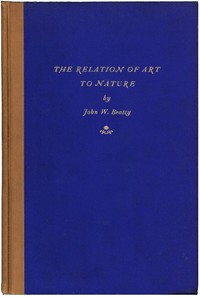
The Relation of Art to Nature — Text and Context
229
8
Project Gutenberg
2016
Art; Nature (Aesthetics)
Readers of public-domain and historical texts
Project Gutenberg digital edition
en
Edition facts
Words: 19,111
Reading time: 84 min
Text sections: 14
Source:
Project Gutenberg record #53477
John W. Beatty, a painter and Carnegie Institute director, examines art's relationship to nature through artists' own statements and philosophical opinions, drawing on examples from Kuo Hsi to Rodin.
Editorial Edition Score
4.6/5
★★★★★
★★★★★
Calculated from edition completeness, EPUB availability, text structure and catalogue metadata. Not a user rating.
Edition quality
John W. Beatty, a painter and longtime director of fine arts at the Carnegie Institute, builds this treatise around a simple but pointed question: what do artists themselves say about their debt to nature? Rather than advancing a single thesis, he assembles and compares statements from painters, sculptors, and philosophers across centuries—from the 11th-century Chinese painter Kuo Hsi to Auguste Rodin. The excerpts show Beatty favoring concrete testimony over abstract theory, as when he recounts a visit to Giovanni Segantini at Maloja and reports the painter's insistence on finishing every picture "in the presence of nature."
Artists Speaking for Themselves
Beatty's method is to let practitioners speak first. The table of contents lists painters and sculptors separately from philosophers, and the excerpts confirm that he grants artists unusual authority. He quotes John La Farge on the two methods of working—directly from nature or from memory—and notes that La Farge considered the difference merely "a different span of memory." Beatty then offers his own observations of Segantini's technique: the painter began with large crayon cartoons, transferred the drawing to canvas, and then carried the canvas to the actual scene. "Absolutely no!" Segantini replied when asked if he ever finished a picture in the studio. The account is firsthand, dated to about twenty years before the book's 1922 publication, and gives the reader a rare glimpse of a working method.
Memory as a Tool, Not a Shortcut
A recurring point in the excerpts is that painting from memory is not a lesser form of art. Beatty uses Anton Mauve as a counter-example to Segantini: Mauve relied on his memory of nature, yet his pictures are described as "direct and forceful" and his knowledge of nature "profound." The implication is that both approaches—direct study and stored recollection—can produce valid art. Beatty does not rank one above the other. Instead, he frames the choice as a matter of temperament or habit. The reader is left to weigh the evidence from multiple artists rather than receive a single doctrine.
The Philosophers' Role in the Argument
Beatty includes a long list of philosophers—from Socrates to Sei-ichi Taki—but the excerpts suggest their function is secondary. The introduction notes that "the man of letters is more given to analysis and finds more words," while artists speak "tersely and to the point." Beatty seems to value the artist's directness over the philosopher's elaboration. The structure of the book, with artists placed before philosophers, reinforces this priority. Readers should note that the excerpts do not reveal how Beatty resolves the tension between the two groups; the treatise may leave the question open, inviting the reader to weigh the testimony.
Symmetry as a Formal Concern
The table of contents includes a section titled "Symmetry," placed between the opinions of philosophers and the conclusion. This suggests Beatty considered formal principles as a separate topic, distinct from the artist-nature relationship. The excerpts do not elaborate on what symmetry means in this context—whether it refers to compositional balance, proportional systems, or something else. Readers should approach this section with attention to how Beatty connects a specific formal concept to the broader theme of art and nature.
Beatty's book is best read as a curated conversation among artists and thinkers, not as a systematic theory. The excerpts show him more interested in gathering testimony than in forcing a conclusion. Readers may find it useful to track which artists Beatty quotes at length and which he merely lists, and to notice how his own painter's eye shapes the descriptions of technique and effect.
Reader reflection
How will you remember this book?
Save your reaction, strongest insight, and memorable passage.
Your progress
0
/
10
2
Did this book hold your interest?
3
Is this a title you would suggest to others?
4
How demanding did the text feel?
5
Could you apply anything you learned?
6
How clearly were the main ideas presented?
7
How strong was your personal connection to the text?
8
Do you expect to return to this book?
9
What is the main idea you are taking away?
10