1

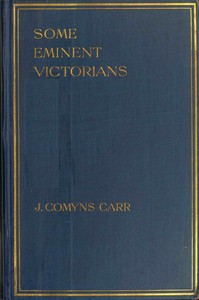
Some eminent Victorians: Personal recollections in the world of art and letters — Reading Notes
875
3
Project Gutenberg
2022
English literature -- 19th century; Great Britain -- Intellectual life -- 19th century; Art, Victorian
Readers of public-domain and historical texts
Project Gutenberg digital edition
en
Edition facts
Words: 85,294
Reading time: 371 min
Text sections: 12
Source:
Project Gutenberg record #68526
J. Comyns Carr's personal recollections of Victorian artists and writers, with anecdotes about Burne-Jones, Dickens's readership, and a comic French railway incident, revealing the era's intellectual life through firsthand encounters.
Editorial Edition Score
4.9/5
★★★★★
★★★★★
Calculated from edition completeness, EPUB availability, text structure and catalogue metadata. Not a user rating.
Edition quality
Carr opens his preface with a pointed anecdote: a young writer tells him that among cultured youth, Dickens is never read after age fourteen. Carr does not refute the claim outright but notes that he knows young people who still regard Dickens as an incomparable genius. This moment establishes the book’s defensive yet affectionate stance toward Victorian achievement. The author positions himself as an impenitent Victorian, aware that his reverence may seem old-fashioned to a generation that believes art, like science, is always advancing. The preface thus frames the recollections not as neutral memoir but as a deliberate counterweight to newer schools of thought.
Anecdotal Evidence of Character
The excerpts show Carr’s method: he builds portraits through small, revealing incidents rather than systematic analysis. The most extended anecdote involves two Scotsmen who, on a train to Paris, occupy a ladies’ compartment and are ejected by officials. Carr, acting as interpreter, explains that the Scotsmen sought privacy for the ladies’ sake. The French officials, initially stern, dissolve into laughter at the explanation. The story ends with the Scotsman later asking, with practical seriousness, where Carr learned his French. The anecdote reveals Carr’s eye for comic detail and his interest in cultural contrasts—Scots pragmatism versus Gallic merriment. It also illustrates how Carr himself appears in the narrative as a facilitator, a role that recurs in other recollections.
The Café Royal as a Meeting Ground
Carr describes learning French through twice-weekly dinners at the Café Royal with Professor Gauthiot, a refugee from Berlin after the Franco-German War. The Café Royal of the 1870s, he notes, was a humble restaurant patronized mainly by foreigners, far from the grand establishment it later became. He lists the few other notable restaurants of the time: Verrey’s, Simpson’s in the Strand, and the old Mitre Tavern by Temple Bar. This passage does more than set a scene; it maps a social geography of literary London. Carr’s detail about the scarcity of restaurants and the Café Royal’s transformation over decades gives the reader a concrete sense of the physical spaces where Victorian intellectual life unfolded. The friendship with Gauthiot, conducted over dominoes and conversation, exemplifies the informal networks that underpin the book’s portraits.
The Limits of the Catalog Subjects
The catalog lists this work under Architecture, English literature, and Victorian intellectual life. Yet the excerpts contain no discussion of buildings or architectural theory. The Architecture classification likely derives from Carr’s professional background as an art critic and theatre designer, not from the book’s content. The English literature subject is better supported: the preface engages with Dickens’s reputation, and the anecdotes involve literary figures. However, the excerpts focus more on social encounters than on literary analysis. The Victorian intellectual life subject fits best, as Carr explicitly defends Victorian values and recounts interactions that illuminate the period’s cultural assumptions. Readers should note that the catalog subjects are broad pointers, not precise descriptions of the book’s contents. The work is primarily a memoir of personal acquaintance, not a survey of art or literature.
Carr’s recollections are best approached as a series of vignettes rather than a unified argument. The preface’s defensive tone may color the portraits that follow, but the excerpts suggest that Carr’s loyalty to his subjects does not prevent him from including humor or self-deprecation. Readers interested in the texture of Victorian social life—the restaurants, the train journeys, the cross-channel misunderstandings—will find more here than in a formal history. The book rewards those who enjoy following a narrator who is both participant and observer, and who values a good story over a comprehensive thesis.
Reader reflection
Your personal reading reflection
Build a private reading journal entry for this title.
Your progress
0
/
10
2
Did this book hold your interest?
3
Is this a title you would suggest to others?
4
How easy was the book to follow?
5
How useful did the reading feel?
6
Which aspect of the book did you value most?
7
How strong was your personal connection to the text?
8
Could you follow the author’s main argument?
9
What is the main idea you are taking away?
10